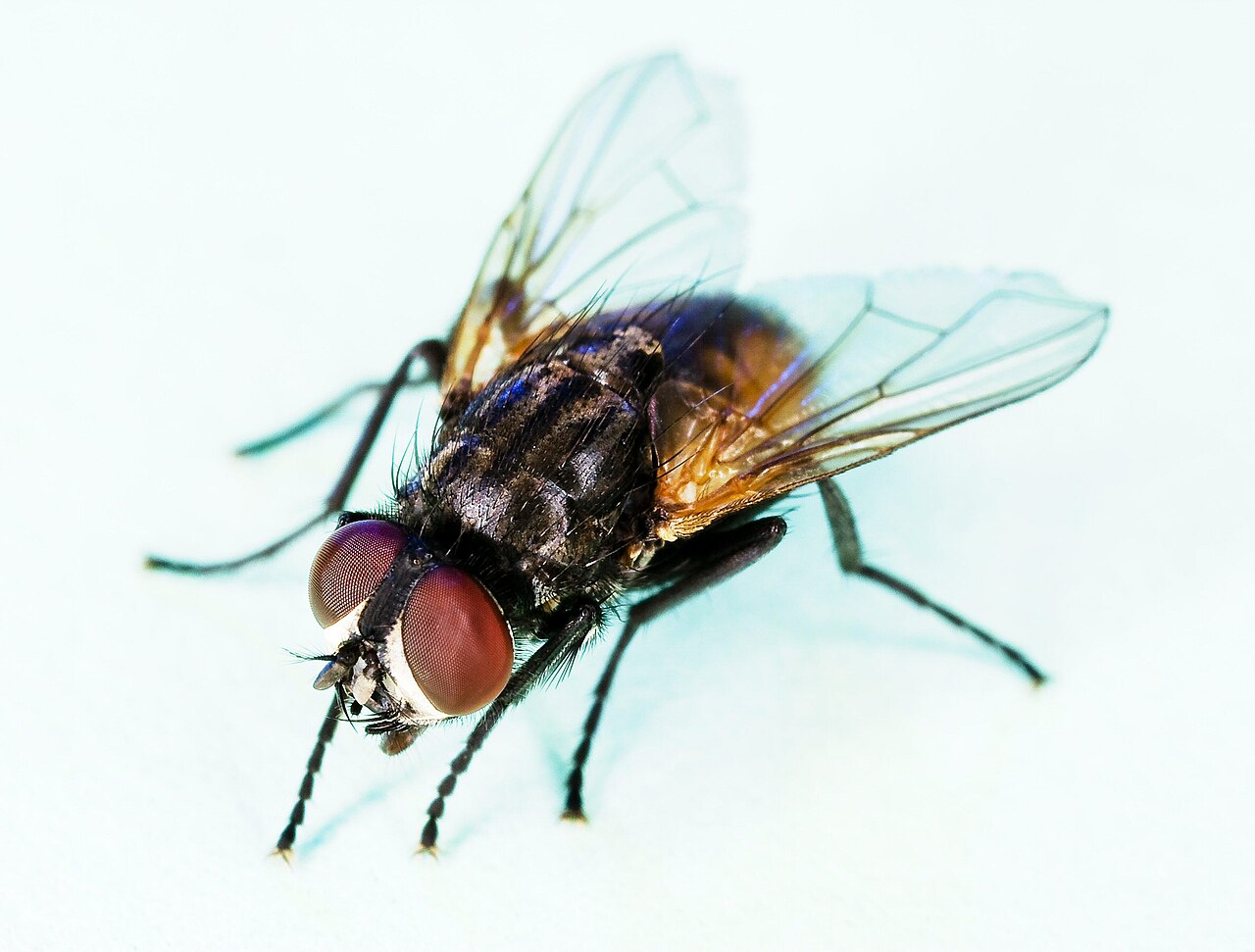
Entity scope
This profile covers Musca domestica. Other gray muscoid flies can look similar and may require clearer body and wing details.
Quick identity
- Scientific name
- Musca domestica
- Entity scope
- One fly species
- Adult size
- Usually about 6–7 mm
- Adult appearance
- Dull gray with four dark thoracic stripes
- Larva
- Cream-colored, legless maggot
- Common context
- Buildings and outdoor areas with accessible moist organic breeding resources
Key characteristics
- Adults are dull gray flies with four darker lengthwise stripes on the thorax.
- The abdomen often shows pale and dark patterning, but appearance changes with sex, angle, and lighting.
- Wing venation and bristle details help separate similar flies.
- One gray fly indoors cannot be identified by room location alone.
Life stages
01
Larva
Legless maggot developing in suitable moist organic material; it does not resemble the adult.
02
Pupa
Brown capsule-like stage near or away from the larval resource.
03
Adult
Mobile gray fly that can disperse from its breeding source.
Where it is found
- Around buildings, animal facilities, waste, and other accessible organic resources.
- Indoors near food handling, windows, doors, and light after entry.
- Adults may travel from outside, so one fly does not prove indoor breeding.
Behavior and activity
- Strong, mobile fliers that repeatedly land and feed on liquid or liquefied resources.
- Adults can disperse from the larval source.
- Repeated patterns and sanitation context matter more than one isolated sighting.
Diet and resources
- Larvae develop in suitable moist decaying organic material.
- Adults use liquid foods or dissolve solid material with saliva before feeding.
Common lookalikes
Why it matters
Hygiene relevance without exaggerated disease claims
House flies can mechanically move microbes between contaminated material and surfaces. A single fly does not prove contamination, illness, or a building-wide sanitation failure.
- Risk depends on source, frequency, and where flies contact food or surfaces.
- Keep identification separate from health diagnosis.
Management direction
- Confirm the fly and distinguish outdoor entry from repeated emergence.
- Locate and address verified breeding resources and access routes.
- Use appropriate sanitation, exclusion, monitoring, or qualified guidance.
Have a pest photo to check?
Start a new photo identification. This Profile gives comparison context; it does not transfer certainty or diagnose your image.
Identify a photoReviewed guidance and sources
Last reviewed August 2026. Sources support the claims listed with them; their limits remain part of the review.
- University of Minnesota Extension — Flies
Supports: Fly morphology, seasonal behavior, breeding-resource context, and household occurrence.
Does not support: Family or species certainty from a blurred image or proof of a particular breeding source.
Scope note: North American household and structural-pest context; local conditions vary.
- USDA-ARS / Wikimedia Commons — House fly reference
Supports: Identity, provenance, licensing, and adult appearance of the pictured specimen.
Does not support: Universal appearance or source location for every house fly.
Scope note: North American household and structural-pest context; local conditions vary.