Quick Answer
Possible mouse droppings are usually small, dark pellets, often tapered at one or both ends. A group along a wall, in a cabinet, or near gnawed packaging supports mouse activity; one pellet or photo alone does not confirm the source.
Evidence strength
Moderate clue
More useful when several intact pellets recur in a mouse-sized travel area and other rodent signs are present.
- A measured group of similarly shaped pellets is more informative than one fragment.
- New pellets after careful cleanup support current activity.
- Gnawing, nesting material, tracks, or an observed mouse increase confidence.
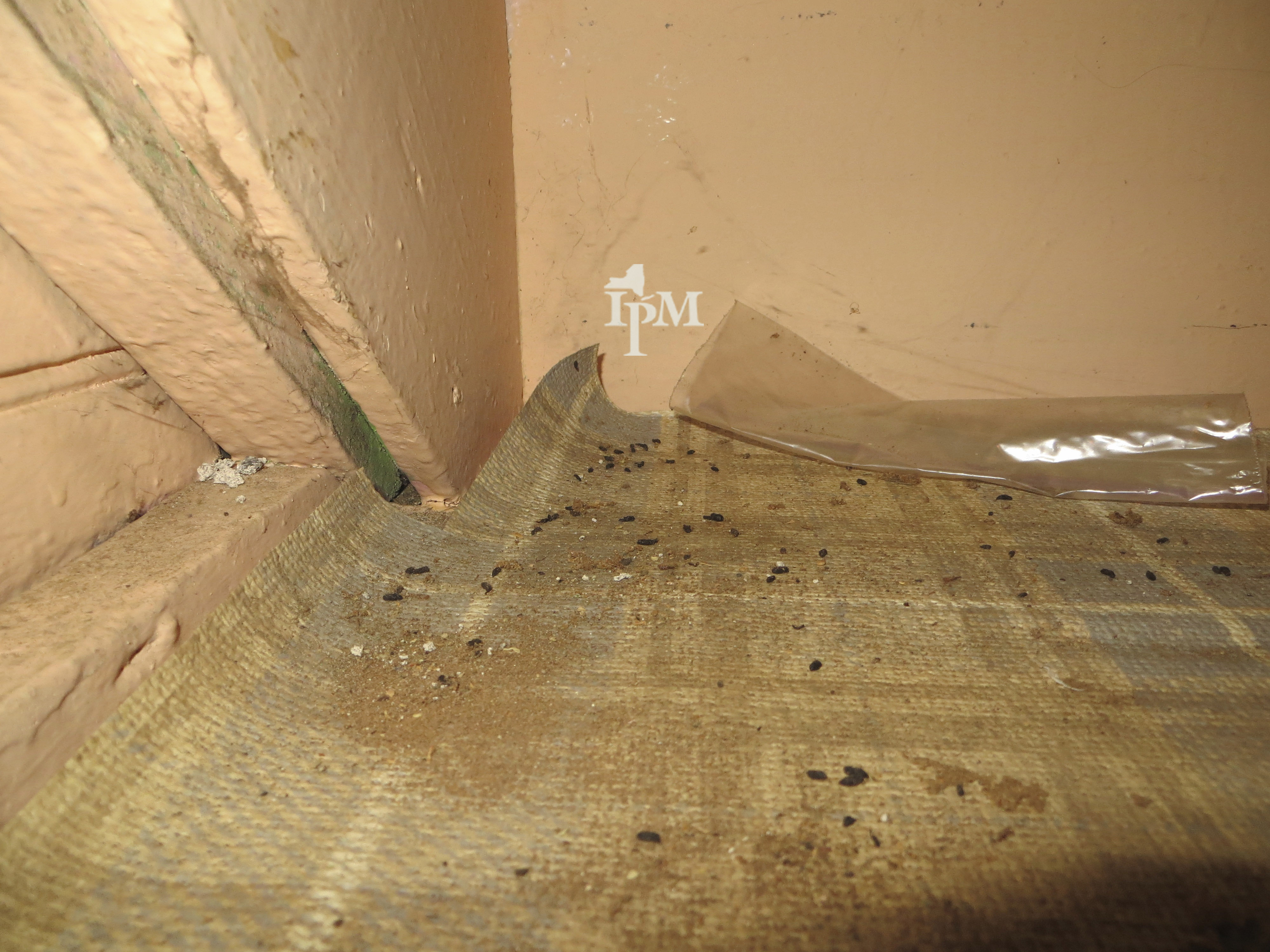
Authentic house mouse droppings in an inspection setting. The photo has no scale; compare several clues together.
- Source
- NY State IPM Program at Cornell University
- Creator
- Matt Frye
- License
- CC BY 2.0
- Reference context
- House Mouse Droppings — Matt Frye / NY State IPM Program at Cornell University; original photograph, displayed without generative alteration.
What it may indicate
- A mouse using an edge, cabinet, pantry, garage, or hidden void as a travel or feeding route.
- Recent activity if carefully cleared locations develop new pellets.
Other explanations
- Larger rat droppings, which vary by species and should be measured rather than guessed from a photo.
- Cockroach droppings, bat guano, seeds, food debris, or crumbled material.
What this evidence cannot prove
- The exact rodent species from appearance alone.
- How many animals are present or where a nest is located.
- Whether a pellet is fresh, infectious, or safe to handle based only on color.
Where to check next
- Follow wall edges, cabinet corners, pipe penetrations, appliance gaps, and food storage areas.
- Look without disturbing the material for gnaw marks, shredded nesting material, tracks, grease marks, or damaged packaging.
Additional evidence to collect
- Photograph several intact pellets beside a ruler without touching them.
- Take a wider photo showing the exact edge, cabinet, or opening.
- After safe cleanup, note whether new pellets appear and where.
Clean without raising dust
Treat rodent droppings as potentially contaminated. Cleanup guidance varies with the setting and amount.
- Keep people and pets away, ventilate when appropriate, and wear gloves.
- Do not sweep or vacuum dry droppings. Wet them with an appropriate disinfectant, follow its label and contact time, then wipe up.
- For heavy contamination, ventilation systems, insulation, or illness after significant exposure, seek qualified local guidance.
Pests associated with similar signs
Relevant Guides
Reviewed community cases
Not sure what you found?
Upload the evidence and its surrounding context. The result supports comparison; it does not create certainty.
Identify a photoExplore next
Reviewed guidance
Last reviewed August 2026. This content supports evidence interpretation and does not replace medical diagnosis, structural inspection, product labels, or local rules.