Entity scope
Ticks form the arachnid order Ixodida. Species, life stage, feeding state, geography, and health relevance vary; this page does not identify every tick to species.
Quick identity
- Taxonomic order
- Ixodida
- Entity scope
- A broad order containing many tick species
- Animal group
- Arachnids, not insects
- Larvae
- Six legs after hatching
- Nymphs and adults
- Eight legs
- Appearance
- Varies by species, stage, sex, and feeding state
Key characteristics
- Ticks are wingless arachnids with a compact body and forward-projecting mouthparts, though details can be hard to see in casual photos.
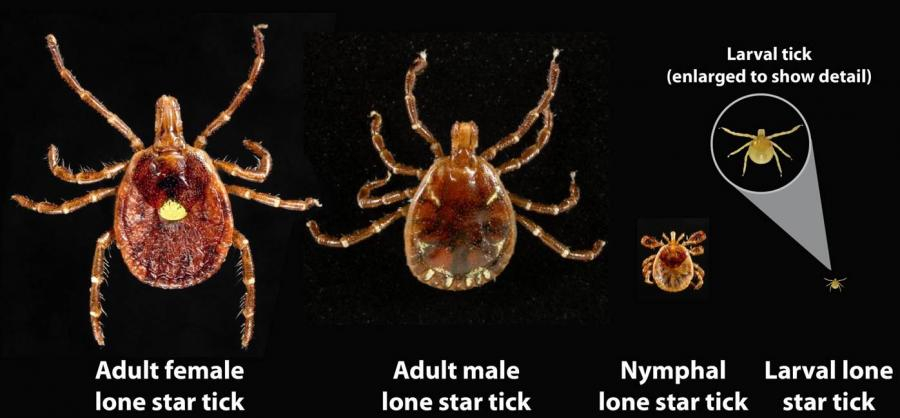
- Larvae have six legs; nymphs and adults have eight.
- Feeding can greatly expand and alter body shape and color.
- Species comparison may require dorsal and ventral views, scale, geography, and life-stage context.
Life stages
01
Larva
The six-legged stage after hatching. Larvae are very small and still vary among tick groups.
02
Nymph
An eight-legged immature stage. Nymphs can be difficult to identify from low-resolution photographs.
03
Adult
An eight-legged reproductive stage. Sex and feeding state may substantially change the visible body.
Where it is found
- On vegetation, leaf litter, wooded edges, grass, or other habitat used by hosts, depending on species and region.
- Attached to people, pets, wildlife, or livestock after contact with suitable habitat.
- Distribution is species-specific; a tick common in one region may be absent or uncommon in another.
Behavior and activity
- Ticks feed on blood at each active life stage and use different host-seeking strategies.
- Attachment and feeding alter appearance; an engorged tick may look unlike an unfed reference.
- A tick observation should be recorded with place, date, host, attachment context, and multiple clear views.
Associated signs
Common lookalikes
Other small arachnids can be mistaken for ticks, especially in unclear images.
Small rounded beetles can resemble ticks at a glance but have insect anatomy.
Flattened insects with six legs; they are not arachnids and lack a tick’s body structure.
Why it matters
Identity, exposure, transmission, and diagnosis are separate
Health relevance varies with species, geography, exposure, attachment context, local epidemiology, and clinical circumstances. Appearance, a species guess, a bite mark, or attachment alone cannot show whether a pathogen was transmitted or diagnose disease.
- A photographed tick can support identification; it does not answer a medical diagnosis question.
- New or concerning symptoms after exposure need appropriate medical or public-health guidance.
Management direction
- If a tick is attached, prioritize prompt, appropriate removal and document the exposure separately from species identification.
- Use clear photographs, scale, geography, and host context for later comparison.
- Removal, symptom monitoring, pet treatment, and yard management belong in the linked Evidence and Guides.
Related Evidence
Related Guides
Have a pest photo to check?
Start a new photo identification. This Profile gives comparison context; it does not transfer certainty or diagnose your image.
Identify a photoReviewed guidance and sources
Last reviewed August 2026. Sources support the claims listed with them; their limits remain part of the review.
- GBIF — Ixodida
Supports: Order-level taxonomic scope.
Does not support: One universal tick appearance or risk level.
- CDC — Tick Lifecycles
Supports: Life stages, leg counts, feeding, and lifecycle variation.
Does not support: Species or disease diagnosis from appearance.
- CDC — Where Ticks Live
Supports: Species-specific distribution and public-health context.
Does not support: Risk outside the stated geographic and epidemiologic context.
Scope note: Primarily United States public-health context.
- CDC — Lone star tick stage image
Supports: Life-stage appearance of the pictured Amblyomma americanum examples.
Does not support: Universal morphology for Ixodida.