Entity scope
This page covers household carpet beetles within the beetle family Dermestidae. Dermestidae includes additional groups, so the family name is not a universal synonym for carpet beetles.
Quick identity
- Taxonomic context
- Household carpet-beetle groups within Dermestidae
- Entity scope
- A variable family-level subset, not one species
- Larvae
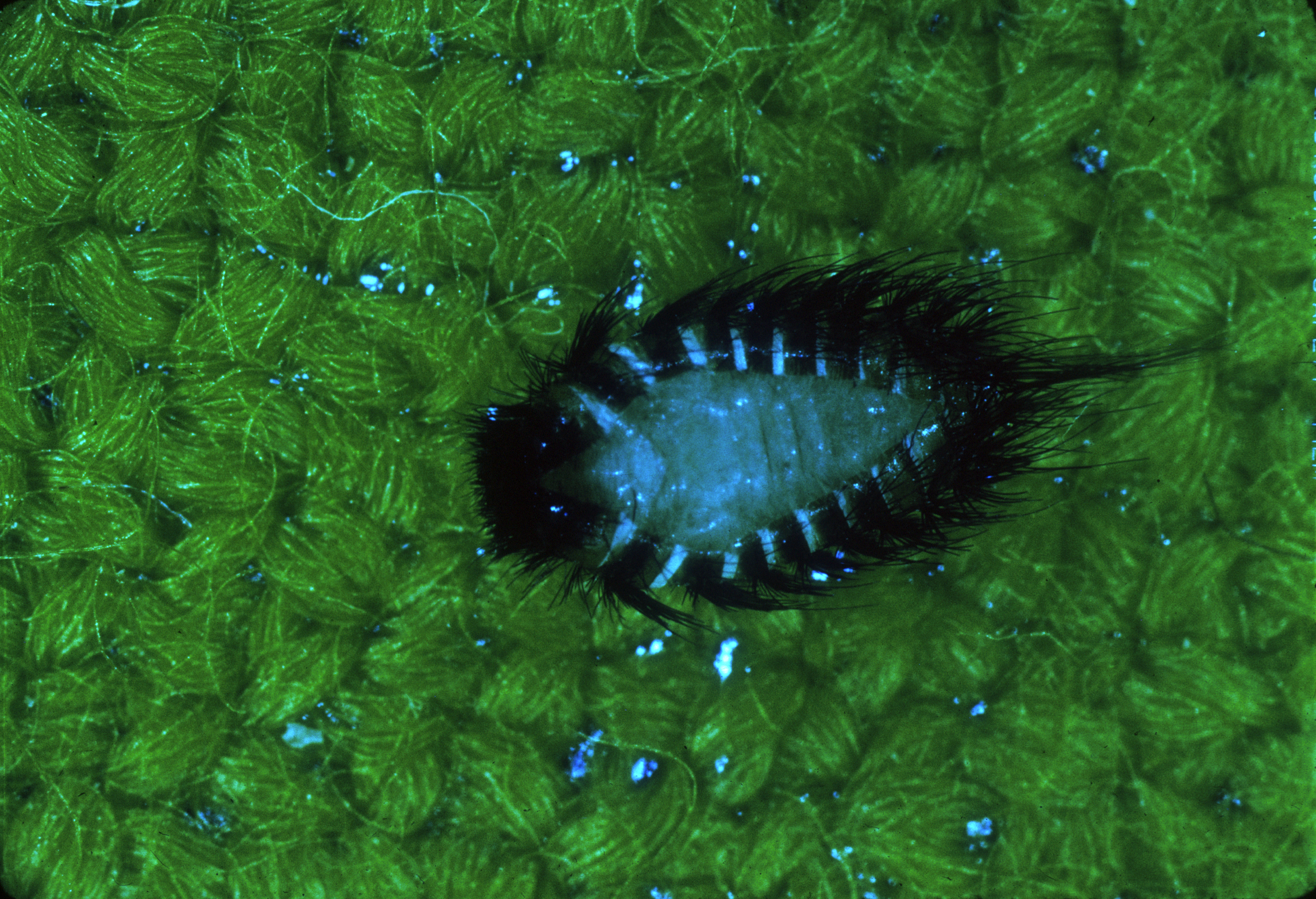
- Elongated to oval, segmented, and usually hairy or bristly
- Adults
- Small oval beetles; colors and scale patterns vary by species
- Damage stage
- Larvae are the stage most associated with household material damage
- Common context
- Natural-fiber materials, lint, stored items, and adult activity near light or flowers
Key characteristics
- Larvae and adults look very different, so stage is the first useful distinction.
- Larvae are typically brownish, segmented, and densely hairy or bristly; form and hair pattern vary.
- Adults are compact, oval beetles and may be uniformly dark or patterned with pale and colored scales.
- A precise species identification often requires clearer adult or larval details than a household photo provides.
Life stages
01
Larva
The material-feeding household stage. Larvae may occur in lint, natural fibers, stored animal products, or quiet edges where suitable resources collect.
02
Adult
Small oval beetles that may be found near windows or outdoors on flowers. An adult indoors does not by itself locate larval damage.
Where it is found
- Carpet edges, closets, stored textiles, upholstery, vents, and undisturbed lint accumulations.
- Items containing wool, fur, feathers, hair, dried insects, or other animal-derived materials.
- Adults may appear near windows or light and can occur outdoors, away from the larval source.
Behavior and activity
- Larvae feed and develop in protected resource-rich locations; adults have different feeding and movement patterns.
- Finding one adult does not prove that nearby fabrics are infested.
- Repeated larvae, cast skins, and compatible material damage together are more informative than one isolated clue.
Diet and resources
- Larvae can use keratin-rich or animal-derived materials such as wool, fur, feathers, hair, and dead insects.
- Species and conditions vary; not every hole or damaged textile is caused by carpet beetles.
Associated signs
A visible bristly larva is more useful than a suspected skin reaction; empty larval skins need source context.
Carpet beetle eggsSmall pale objects are weak evidence unless stage and location are corroborated.
Carpet beetle skin irritationCarpet beetles do not bite; larval hairs may irritate some people, but skin appearance is not diagnostic.
Common lookalikes
Bed bugs are flattened, wingless blood-feeding insects, not bristly beetle larvae.
Clothes mothsLarvae can damage similar materials but differ in body form, cases, and webbing.
Small stored-product beetles may look similar as adults but point to different resources.
Why it matters
Material damage and skin-safety boundary
Larvae can damage susceptible household materials. Carpet beetles do not bite people, although larval hairs or bristles may irritate some individuals. A skin pattern cannot diagnose carpet beetles or a medical condition.
- Base conclusions on a specimen, cast skins, material damage, and the resource context together.
- Persistent or concerning skin symptoms belong with a healthcare professional, not image-only pest diagnosis.
Management direction
- Identify whether the specimen is a larva or adult and locate the relevant material or food source.
- Inspect the resource context and move to appropriate control guidance only after the signs fit.
- A complete cleaning, laundering, storage, or treatment workflow belongs in the Guides below.
Related Evidence
Related Guides
Reviewed Community
Have a pest photo to check?
Start a new photo identification. This Profile gives comparison context; it does not transfer certainty or diagnose your image.
Identify a photoReviewed guidance and sources
Last reviewed August 2026. Sources support the claims listed with them; their limits remain part of the review.
- ITIS — Dermestidae
Supports: Family-level taxonomic context.
Does not support: That every dermestid is a household carpet beetle.
- University of Minnesota Extension — Carpet beetles
Supports: Adult/larval differences, household resources, locations, and damage context.
Does not support: Species certainty from an unclear photograph.
Scope note: North American household context.
- Penn State Extension — Carpet Beetle Dermatitis
Supports: Larval-hair irritation boundary and that carpet beetles do not bite.
Does not support: Diagnosis of a rash or proof of carpet beetles from skin appearance.
- CSIRO — verified larval reference image
Supports: Appearance of the photographed carpet beetle larvae.
Does not support: Adult appearance or the full diversity of Dermestidae.