Quick answer
What to know first
If you have an intact insect, compare three features together. Flying ants typically have bent antennae, a pinched waist, and front wings longer than the rear pair. Termite swarmers typically have straighter antennae, a broad body connection, and two pairs of similarly sized long wings. One loose wing or damaged trait is not enough.
Start here
- Photograph an intact insect from above and from the side.
- Save shed wings or a specimen in a sealed container.
- Inspect the emergence area for wood, moisture, trails, tubes, pellets, or damage.
Side-by-side comparison
| Feature | Flying ant | Termite swarmer |
|---|---|---|
| Antennae | Usually elbowed or bent | Usually straight or gently curved |
| Waist | Clearly pinched between thorax and abdomen | Broad, without a narrow pinch |
| Wings | Front pair usually longer than rear pair | Both pairs usually similar in length |
| Body context | May occur with ant trails or carpenter-ant debris | May occur with discarded wings, mud tubes, pellets, or damaged wood |
| Swarm context | Can emerge indoors or enter from outside | Indoor emergence or repeated wings near wood deserves structural inspection |
| Best confirmation | An intact insect showing the waist, antennae, and both wing pairs | An intact swarmer plus matching wings and building context |
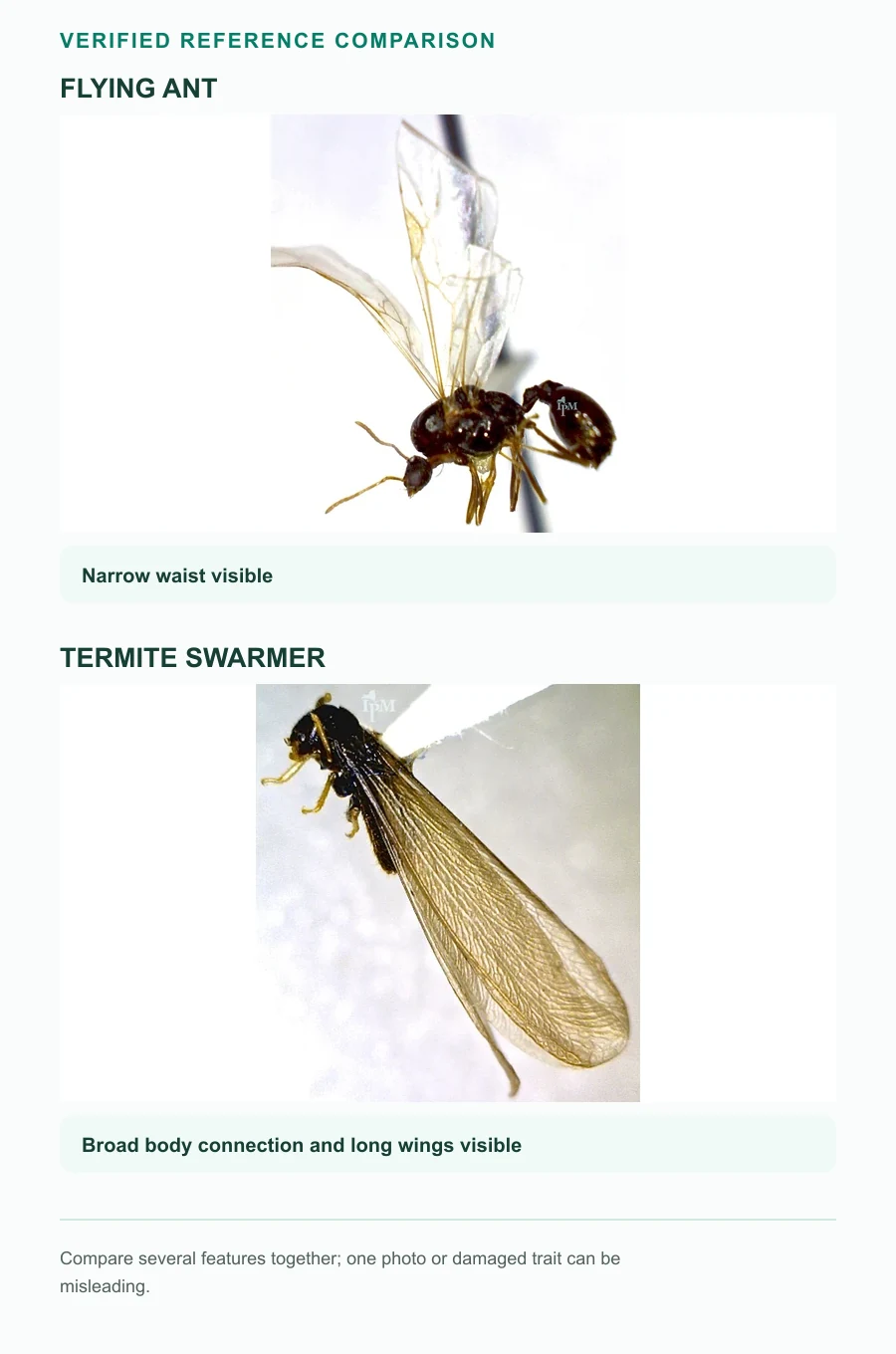
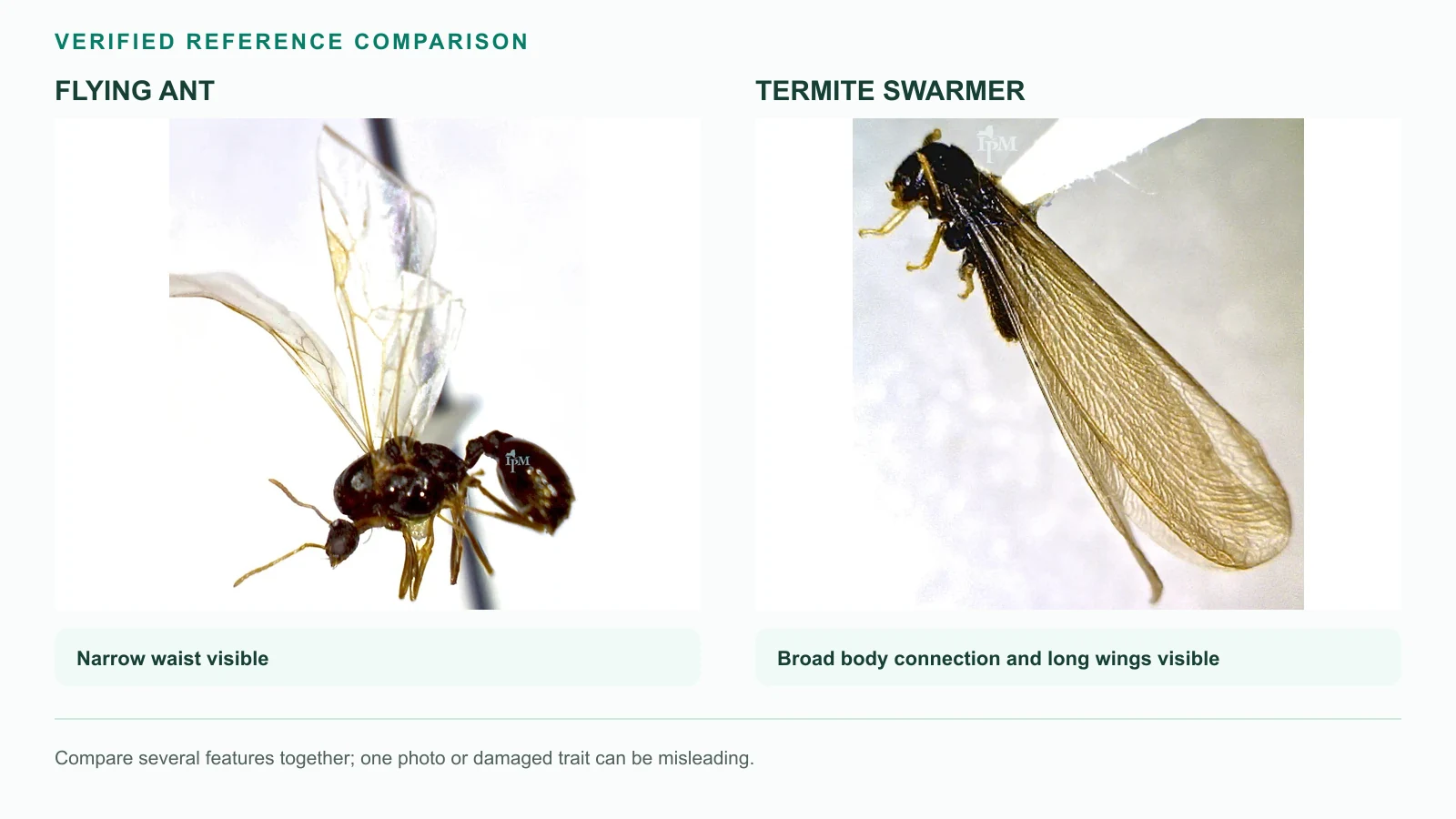
Reference image credits
- Pavement Ant Alate (winged) — NY State IPM Program at Cornell University · CC BY 2.0 · cropped, resized, and arranged for comparison.
- Termite Alate (winged swarmer) — NY State IPM Program at Cornell University · CC BY 2.0 · cropped, resized, and arranged for comparison.
Most useful distinguishing clues
- Use antennae, waist, and intact wing proportions together.
- Compare more than one insect because wings and antennae can break.
- Treat the location and associated evidence as part of the identification.
Where each is usually found
Flying ants
Near windows, doors, lights, outdoor colonies, or moisture-damaged wood when carpenter ants are involved.
Termite swarmers
Near windows and lights after emergence; repeated indoor swarmers may trace back to structural wood or soil-connected entry points.
Evidence differences
Ant-associated evidence
Organized trails, workers with pinched waists, or coarse mixed debris around damp wood may support an ant source.
Termite-associated evidence
Matching shed wings, mud shelter tubes, hard pellet piles, or internally damaged wood raise termite concern; termite groups leave different evidence.
What photos alone may not confirm
A distant swarm photo, loose wings without scale, or a damaged insect may not show the decisive anatomy. A photo also cannot establish colony location, species, or structural damage by itself.
What to inspect next
- Window and door frames where insects collected.
- Foundations and crawl spaces for mud tubes or soil-connected entry.
- Trim, attic wood, and furniture for pellets or small kick-out openings.
- Moist or softened wood for ant galleries and mixed debris.
What to do depending on the result
Traits support flying ants
Look for the trail or emergence point and investigate moisture if carpenter ants are possible.
Traits support termites
Document the insects and evidence, avoid destroying all signs, and arrange a licensed termite inspection when activity is indoors or structural wood may be involved.
Still ambiguous
Keep a specimen and upload clear close-ups rather than treating based on a single uncertain feature.
FAQ
Are flying ants harmless?
Some are nuisance swarmers, but carpenter ants can indicate moisture-damaged wood and should be investigated.
Do termite swarmers mean active damage?
They indicate termite activity nearby, but inspection is needed to locate the colony and assess damage.
Still can't tell the difference?
Upload a clear photo and compare the result with verified pest information.
Identify from photoExplore next
Continue with verified context
Related pest profiles
Related evidence
Related guides
Reviewed guidance · Last reviewed August 2026
Based on Pest Or Not verified knowledge and authoritative pest-management references.
How we review content