Quick answer
What to know first
Start at the place where people sleep or rest: mattress seams, box-spring edges, bed-frame joints, and the headboard. Work outward to nearby furniture and cracks while looking for live bugs, dark fecal spotting, pale eggs, and cast skins.
Start here
- Use a bright flashlight and inspect one resting area at a time.
- Photograph evidence in place before cleaning or moving it.
- Do not use bite appearance alone to confirm bed bugs.
What you're looking for
Look for physical evidence in protected seams, joints, cracks, and folds close to where people sleep or rest. Use several compatible signs together rather than relying on bite appearance.
Where to inspect first
- Mattress seams and labels
- Box spring and foundation edges
- Bed-frame joints and headboard
- Nearby furniture and cracks around the sleeping area
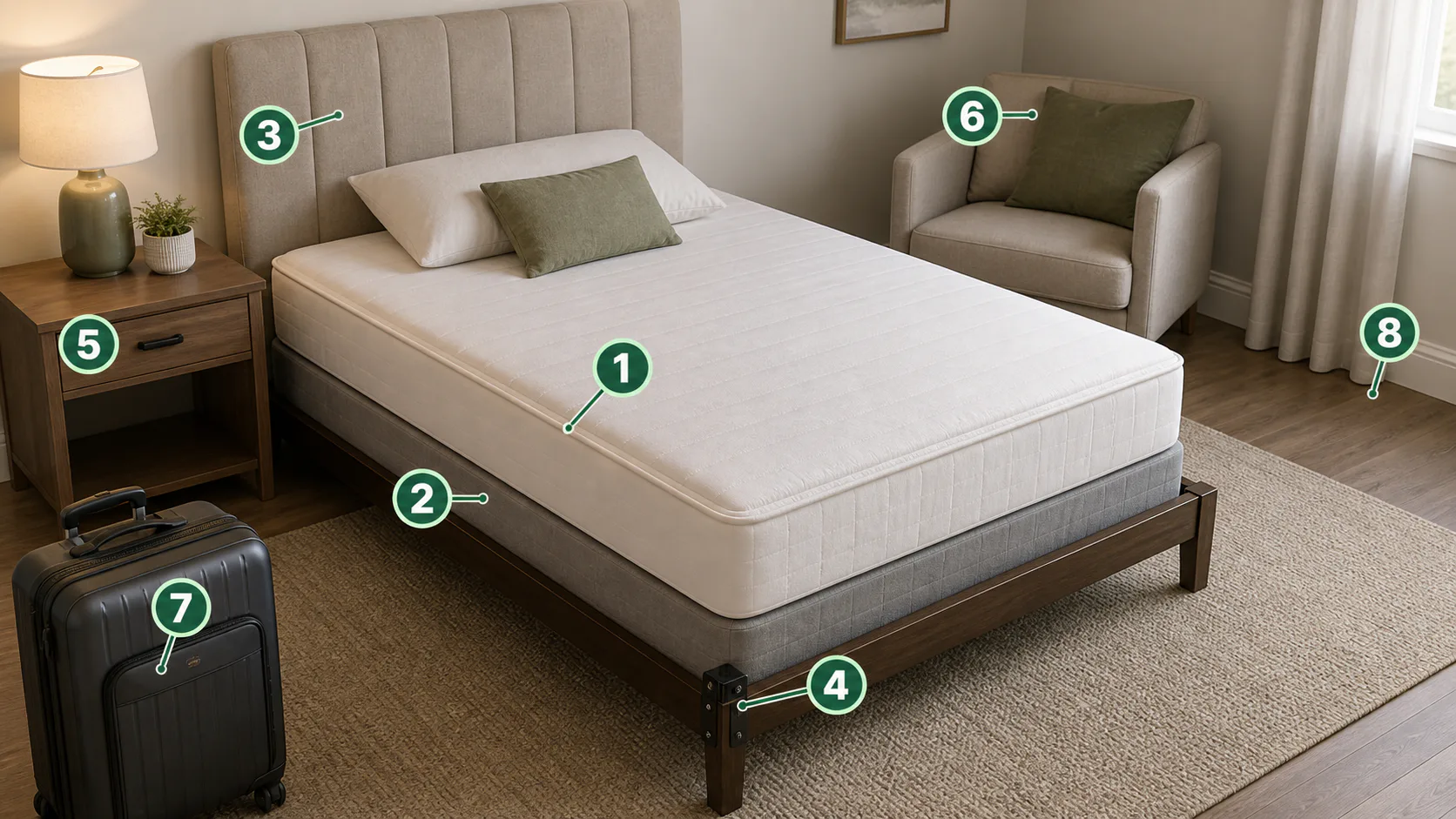
Step-by-step inspection
- 1
Mattress seams and labels
Check piping, tufts, labels, handles, and the underside without carrying the mattress into another room.
- 2
Box spring and foundation
Inspect fabric edges, staples, corner guards, and accessible internal framing.
- 3
Bed frame and headboard
Use a flashlight around joints, screw holes, slats, brackets, and wall-facing surfaces.
- 4
Nearby furniture
Inspect nightstand joints, drawer corners, upholstered seams, and items touching the bed.
- 5
Cracks near sleeping areas
Check baseboards, trim gaps, curtain folds, and accessible wall junctions before expanding to other rooms.
Visual clues
Live bugs
Flat, oval insects in seams, joints, screw holes, or fabric folds; young stages can be small and pale.
Fecal spotting
Dark dots or stains clustered near a harborage. A stain alone can have other causes, so look for a repeated pattern and additional evidence.
Eggs and cast skins
Tiny pale eggs or empty shed skins protected inside cracks and fabric edges.
Evidence to look for
- A recognizable live bug
- Dark fecal spotting clustered near a hiding place
- Tiny pale eggs
- Empty cast skins from growing nymphs
What can be confused with bed bug evidence
Carpet beetle larvae or cast skins
These are often bristly or hairy rather than flat, smooth bed bugs.
Ordinary stains and debris
Ink, mold, dirt, crumbs, and other insect remains can resemble isolated spotting or eggs.
Other biting causes
Fleas, mosquitoes, skin irritation, and other conditions can produce nonspecific marks; skin appearance is not species confirmation.
How to confirm
- Capture a clear top-down and side-view photo with an object for scale.
- Look for more than one evidence type in the same protected area.
- Use interceptors or monitors to collect time-based evidence.
- Ask a qualified pest professional when the specimen or evidence remains ambiguous.
What the photo or evidence cannot prove
A blurry image, an isolated stain, or bite-like marks cannot establish species, infestation size, or whether activity is current. Confirmation becomes stronger when a recognizable specimen and multiple consistent signs occur together.
What to do after finding evidence
- Photograph and contain the specimen or item without spreading it.
- Map the rooms and resting areas with physical evidence.
- Avoid foggers or broad treatment before identification.
- Use the treatment guide only after evidence supports bed bug activity.
FAQ
Can bed bugs hide in walls?
Yes. They can use cracks, baseboards, outlets, and shared-wall gaps when activity grows or spreads.
Should I inspect sofas too?
Yes, especially if people sleep or rest there, or if bites occur away from the bedroom.
Found something during your inspection?
Upload a photo of the pest or evidence.
Identify what you foundExplore next
Continue with verified context
Related pest profiles
Related evidence
Related guides
Reviewed guidance · Last reviewed August 2026
Based on Pest Or Not verified knowledge and authoritative pest-management references.
How we review content