Quick answer
What to know first
Cockroach droppings are often pepper-like, coffee-ground-like, or ridged depending on species. Mouse droppings are usually larger, rice-shaped, and pointed at the ends. Location and nearby evidence are just as important as shape.
Start here
- Whether droppings are tiny specks or larger rice-shaped pellets
- Cabinet hinges, appliance seams, drawers, and under sinks
- Gnaw marks, shredded nesting material, egg cases, or live insects
Side-by-side comparison
| Diagnostic clue | How to compare Cockroach Droppings and Mouse Droppings | How much it proves |
|---|---|---|
| Clue 1 | Cockroach droppings often collect in corners, hinges, appliance seams, and tight cracks | Use with the other listed clues and the finding location; one clue alone may not confirm the source. |
| Clue 2 | Mouse droppings are usually larger and often follow walls, drawers, pantries, or hidden runways | Use with the other listed clues and the finding location; one clue alone may not confirm the source. |
| Clue 3 | Cockroach evidence may include egg cases, shed skins, odor, and nighttime sightings | Use with the other listed clues and the finding location; one clue alone may not confirm the source. |
| Clue 4 | Mouse evidence may include gnaw marks, nesting material, rub marks, and food damage | Use with the other listed clues and the finding location; one clue alone may not confirm the source. |
Most useful distinguishing clues
- Cockroach droppings often collect in corners, hinges, appliance seams, and tight cracks
- Mouse droppings are usually larger and often follow walls, drawers, pantries, or hidden runways
- Cockroach evidence may include egg cases, shed skins, odor, and nighttime sightings
- Mouse evidence may include gnaw marks, nesting material, rub marks, and food damage
Location and context
Small dark droppings in a kitchen or cabinet can point to either cockroach or mouse activity. The safest comparison uses size, shape, quantity, location, and nearby evidence such as gnaw marks, grease marks, egg cases, or nighttime insect activity.
- Whether droppings are tiny specks or larger rice-shaped pellets
- Cabinet hinges, appliance seams, drawers, and under sinks
- Gnaw marks, shredded nesting material, egg cases, or live insects
Evidence differences
- Compare this clue with the finding location and the other listed evidence: Cockroach droppings often collect in corners, hinges, appliance seams, and tight cracks
- Compare this clue with the finding location and the other listed evidence: Mouse droppings are usually larger and often follow walls, drawers, pantries, or hidden runways
- Compare this clue with the finding location and the other listed evidence: Cockroach evidence may include egg cases, shed skins, odor, and nighttime sightings
What photos alone cannot confirm
A blurry, damaged, or out-of-context photo may hide the feature that separates the alternatives. A photo also may not establish the source, extent, or whether the evidence is current.
What to inspect next
- 1
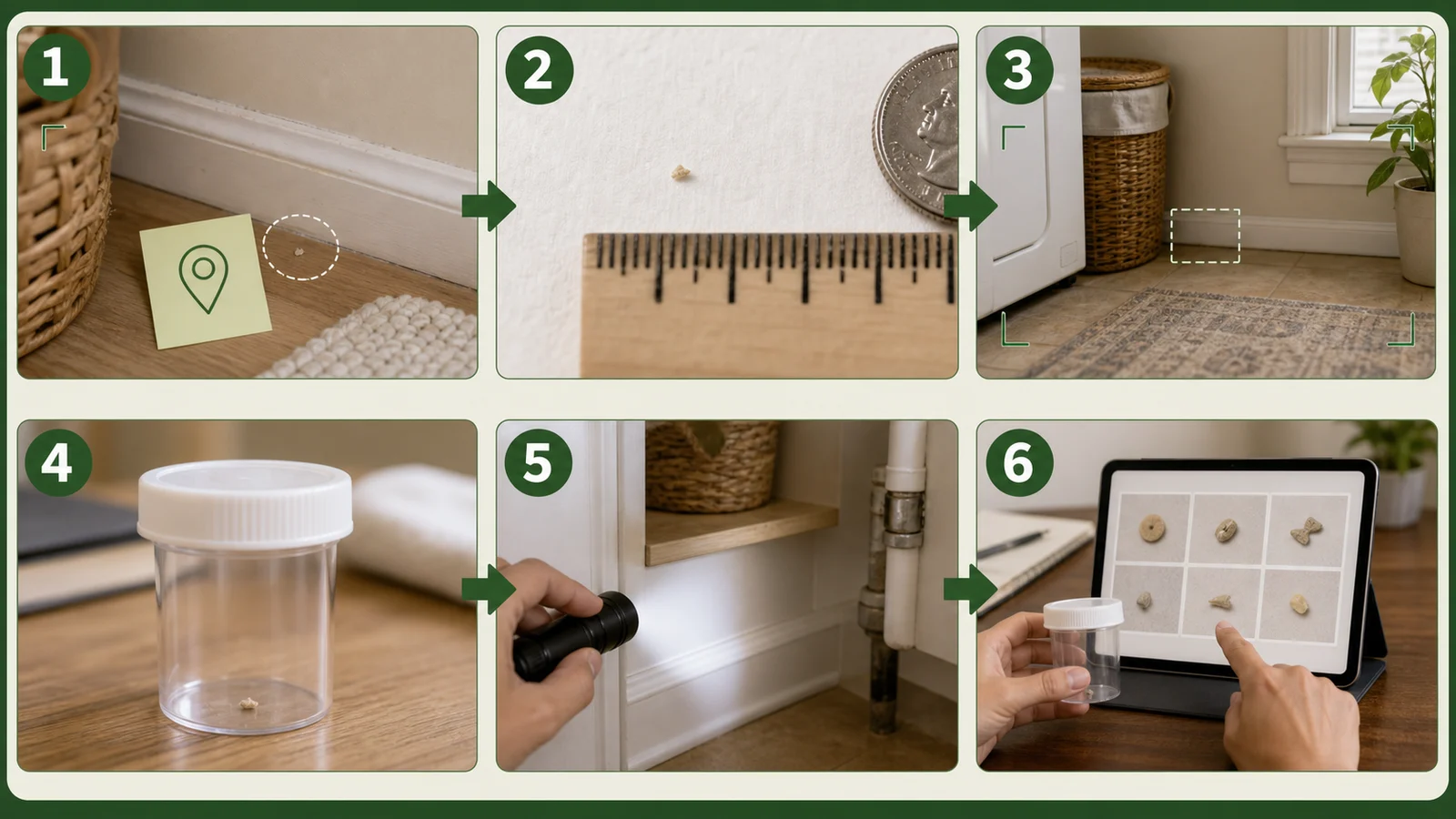
Photograph the droppings and note the exact location before cleanup
Photograph the droppings and note the exact location before cleanup.
- 2
Use gloves and damp cleanup methods instead of dry sweeping
Use gloves and damp cleanup methods instead of dry sweeping.
- 3
Check for roach egg cases, live insects, gnaw marks, and entry gaps
Check for roach egg cases, live insects, gnaw marks, and entry gaps.
- 4
Choose baiting, trapping, or exclusion only after the evidence points to a likely source.
Choose baiting, trapping, or exclusion only after the evidence points to a likely source.
What to do depending on the result
Clues favor Cockroach Droppings
Document the strongest matching features and follow the actions that apply to Cockroach Droppings; keep checking for corroborating evidence.
Clues favor Mouse Droppings
Document the strongest matching features and follow the actions that apply to Mouse Droppings; keep checking for corroborating evidence.
Still ambiguous
Keep a specimen or clearer photos when safe, and avoid treatment based on one uncertain distinction.
What not to assume
Dry sweeping unknown droppings
Dry sweeping unknown droppings
Treating for roaches before checking rodent evidence
Treating for roaches before checking rodent evidence
Ignoring fresh droppings near food or cookware
Ignoring fresh droppings near food or cookware
When to call a professional
Call a professional when droppings keep appearing, rodent entry points are unclear, or roach evidence appears in multiple rooms.
FAQ
Can cockroach droppings look like mouse droppings?
Large cockroach droppings can be confused with small rodent droppings, so size, location, and nearby evidence should be compared together.
Should I clean the droppings before identifying them?
Photograph them first, then clean carefully using damp methods so evidence is not lost and dust is not spread.
Still comparing the possibilities?
Upload a clear photo and use the result alongside the distinguishing clues.
Identify from photoExplore next
Continue with verified context
Related pest profiles
Related evidence
Related guides
Reviewed guidance · Last reviewed August 2026
Based on Pest Or Not verified knowledge and authoritative pest-management references.
How we review content